The USPTO's official estimate is 12–18 months from filing to registration if everything goes smoothly. In practice, "smoothly" means no office actions, no oppositions, and no complications with your application. That's not always the case.
Here's what the actual timeline looks like, what can derail it, and how to track your application along the way.
The typical timeline
Filing → First office action or approval (3–4 months)
After you file your application, the USPTO assigns an examining attorney. Currently, you can expect to wait about 3–4 months before that attorney reviews your application. They check for technical issues (wrong class, incomplete specimens, missing fees) and substantive issues (likelihood of confusion with existing marks, descriptiveness).
If everything is in order and there's no conflict in the database, you'll get a Notice of Publication — moving your application to the next step. If there are issues, you'll get an Office Action.
Publication for opposition (30 days)
Once approved by the examiner, your mark is published in the USPTO Official Gazette for a 30-day opposition period. Any third party who believes your mark would harm them can file a Notice of Opposition with the Trademark Trial and Appeal Board (TTAB) during this window.
Most applications pass through this period without opposition. But if you're filing in a crowded category or your name is close to a large brand's mark, watch for it.
Registration certificate (2–3 months after publication)
If no one opposes, the USPTO issues your registration certificate within about 8–12 weeks of the opposition period ending. For use-based applications (where you're already using the mark in commerce), that's it — you're registered.
For intent-to-use applications, you still need to file a Statement of Use (or an extension request) before the certificate is issued. More on this below.
What can add months to the process
Office Actions
An Office Action is a letter from the USPTO examiner explaining why your application can't proceed as filed. Common reasons include: likelihood of confusion with an existing mark, the mark being merely descriptive of your goods or services, technical issues with the specimen showing use, or incorrect identification of goods/services.
You have 3 months to respond (extendable to 6 months for a fee). If you respond and the examiner is satisfied, the application continues. If not, you might get a Final Office Action — which you can appeal, but that adds more time.
Office Actions are common. According to USPTO data, a significant portion of applications receive at least one. This doesn't mean your mark won't register — it means there's a back-and-forth with the examiner that extends the timeline by 3–12 months.
Oppositions
If someone files an opposition during the 30-day publication period, your application goes into an inter partes proceeding before the TTAB. These can take anywhere from several months to a few years to resolve, depending on complexity. Oppositions are relatively rare but take the most time when they happen.
Intent-to-use applications
If you filed an intent-to-use (ITU) application — meaning you hadn't started using the mark yet at the time of filing — you'll need to file a Statement of Use (SOU) once you begin using it commercially. You have 6 months after the Notice of Allowance to file the SOU, with up to five 6-month extensions available (each costs $125 per class).
ITU applications take longer overall but give you an earlier priority date, which can matter if someone else tries to file a similar mark.
How to track your application
Every trademark application gets a serial number at filing. You can use this to look up your application status at any time.
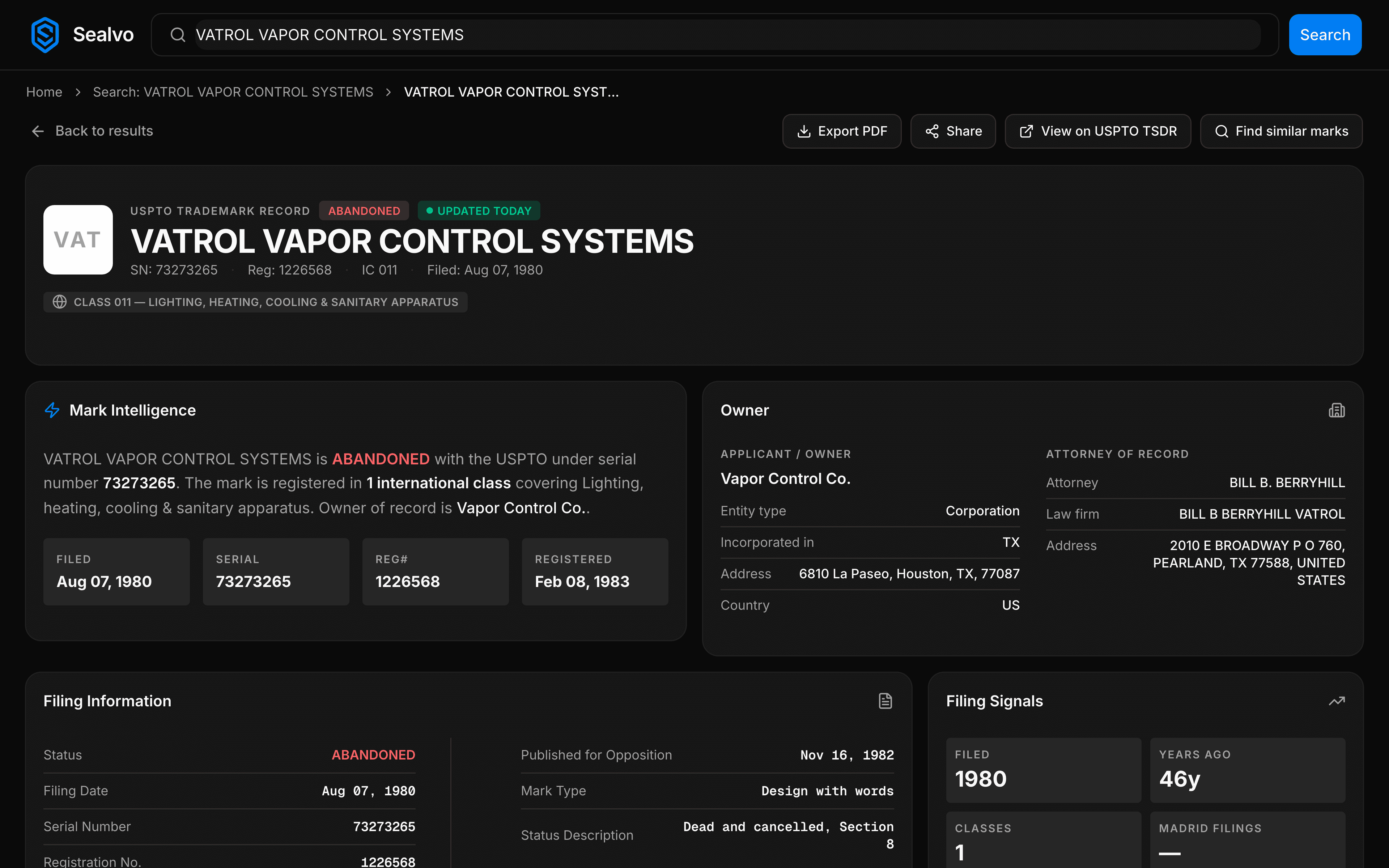
On Sealvo, search your serial number directly to see your current status, prosecution history, important dates, and any pending deadlines. The prosecution history shows every action taken on the application — examiner letters, responses, publication notices, everything.
Can you speed it up?
Somewhat. Using pre-approved goods/services descriptions from the USPTO's ID Manual (instead of writing custom language) tends to result in fewer Office Actions because the descriptions are already acceptable to examiners — and it avoids the $200/class surcharge for custom descriptions added in January 2025.
There's also a petition process to accelerate examination in limited circumstances (typically if you're in active litigation or facing imminent infringement harm), but this isn't available to most applicants.
The most reliable way to avoid delays is a clean application: correct class, accurate specimen, no conflicts in the search, and precise goods/services language. An attorney who handles trademark work regularly knows which descriptions tend to sail through and which attract Office Actions.
What you can do with a pending mark
While your application is pending, you can legally use the ™ symbol (not ®, which is reserved for registered marks). You have the priority date from your filing, which matters if someone tries to file a similar mark later. And in most cases, you can begin using the mark commercially while the application is pending (assuming you filed as use-based, or you've started use on an ITU application).
You can also search for conflicting pending applications on Sealvo and monitor them. If a similar application files after yours, your earlier filing date gives you priority — but you'd want to know about it.
To check the status of any trademark application — yours or anyone else's — search by serial number on Sealvo. You'll see the current status, prosecution history, and any deadlines associated with the record.