Trademark, copyright, and patent are three different types of intellectual property protection. They're often confused with each other — and using the wrong one (or assuming one covers you when it doesn't) can leave real gaps in how your business is protected.
Here's what each one actually covers, when you need it, and what it doesn't do.
The short version
- Trademark: Protects brand identifiers — names, logos, slogans that distinguish your goods or services from others in the market
- Copyright: Protects original creative works — writing, music, code, art, film, etc.
- Patent: Protects inventions — new and useful processes, machines, products, or compositions of matter
These are not interchangeable, and they can overlap. A product might have a trademarked name, copyrighted packaging copy, and a patented mechanism — all at the same time.
Trademark: protecting your brand identity
A trademark covers the identifiers that tell consumers who made something. That includes:
- Business names and brand names
- Product names
- Logos and design marks
- Slogans ("Just Do It," "Think Different")
- Distinctive colors, sounds, or packaging in some cases (trade dress)
Trademark rights come from use in commerce — you don't need to register to have some protection. But federal registration through the USPTO gives you nationwide exclusive rights and a legal presumption of ownership that unregistered marks don't have.
What trademark doesn't protect: the underlying product, the actual words or images in a creative sense, or an invention. "Nike" as a trademark protects the brand name — it doesn't protect Nike's shoe designs (trade dress, sometimes patents) or their marketing copy (copyright).
Trademarks can last indefinitely, as long as you keep using the mark in commerce and file the required maintenance documents (Section 8 declaration between years 5–6, renewal every 10 years).
Copyright: protecting creative works
Copyright protects original works of authorship the moment they're created and fixed in a tangible form. No registration required for the protection to exist — but registration (through the US Copyright Office) is required to sue for statutory damages in a US court.
What copyright covers:
- Written content: blog posts, books, articles, website copy
- Software code
- Music: compositions and recordings
- Visual art: photographs, illustrations, paintings
- Films and video
- Architecture
Copyright gives the owner the exclusive right to reproduce, distribute, display, perform, and create derivative works from the copyrighted material.
What copyright doesn't protect: ideas, facts, concepts, systems, or methods — only the specific expression of them. Copyright doesn't protect a business name, a logo (as a brand identifier — that's trademark), or an invention.
Duration: For works created after 1978, copyright lasts the life of the author plus 70 years (or 95 years from publication for corporate works).
Patent: protecting inventions
A patent gives an inventor the exclusive right to make, use, sell, or import an invention for a limited period. In exchange, the inventor publicly discloses how the invention works — the "bargain" with society that advances public knowledge.
Types of patents in the US:
- Utility patents — Cover new and useful processes, machines, manufactures, or compositions of matter. By far the most common. Duration: 20 years from filing.
- Design patents — Cover new, original ornamental designs for a manufactured article. Duration: 15 years from grant.
- Plant patents — Cover distinct new varieties of asexually reproduced plants. Rare.
Patent protection requires application and examination through the USPTO. An invention must be novel (not previously known or described publicly), non-obvious (not obvious to someone skilled in the relevant field), and useful.
What patents don't protect: abstract ideas, laws of nature, natural phenomena, or mental processes. Software and business methods occupy contested ground — some are patentable, some aren't, and the law here has shifted over the years.
Important timing rule: In the US, you have a 1-year grace period to file a patent after publicly disclosing the invention. After that, you're barred. In most other countries, public disclosure before filing permanently bars you. If you think you might have a patentable invention, talk to a patent attorney before you publish anything about it.
Which one does your business need?
Most businesses need more than one, covering different assets:
- Your brand name and logo → Trademark
- Your website copy, articles, and marketing content → Copyright (exists automatically; register for ability to sue for damages)
- Your software's source code → Copyright (and possibly patents for novel methods)
- A novel product mechanism or process → Patent (file before any public disclosure)
- Your product's distinctive packaging or appearance → Trade dress (a subset of trademark)
Cost comparison
These differ significantly in cost:
- Copyright registration: $45–$65 for online registration of a single work. Optional but recommended.
- Trademark registration (USPTO): $350 per class base fee (as of January 2025), per mark. Attorney fees for preparation and filing typically add $500–$1,500. Ongoing maintenance costs every 5–10 years.
- Utility patent: USPTO filing fees range from $800–$3,000 depending on entity size. Attorney fees for drafting and prosecution typically add $5,000–$15,000. Total cost for a complex patent can exceed $20,000.
The practical implication: most early-stage businesses can afford trademark registration (and should do it). Patents require careful prioritization — file for the things that create real competitive moats, not just because something is novel.
Where they overlap
A single product can be protected by multiple types simultaneously:
- A phone could have utility patents covering its hardware, design patents covering its appearance, a trademark on its name, copyright on its software, and trade dress protection for its distinctive visual design
- A book has copyright in the text and potentially a trademark in the series name
- A brand's distinctive product shape might qualify for both design patent protection (time-limited) and trade dress (potentially perpetual)
Understanding where these overlap — and where each one starts and ends — helps you protect the assets that actually matter for your business model.

What Sealvo covers
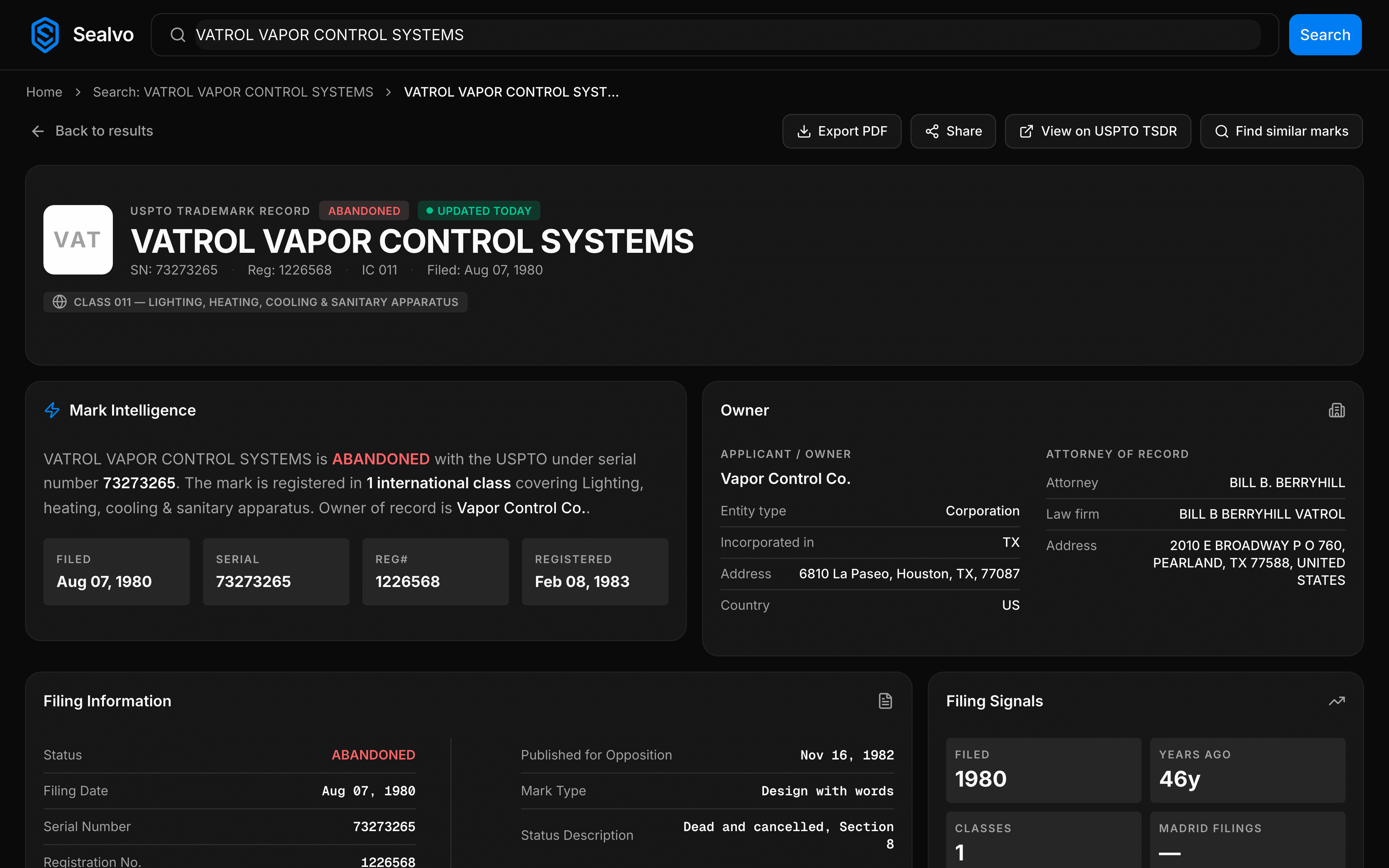
Sealvo searches the USPTO trademark database — all 15 million registered, pending, and abandoned trademark records. If you're researching a brand name before filing or checking a competitor's trademark portfolio, that's what you're looking for.
Copyright records are held at the US Copyright Office (copyright.gov). Patent records are searchable at USPTO's patent search (patents.google.com or USPTO's own system).
For trademark questions specifically — searching before you file, checking a name's availability, or researching what a competitor has registered — search the USPTO database on Sealvo. Free, instant, 15 million records.